Free Creation Unit Study
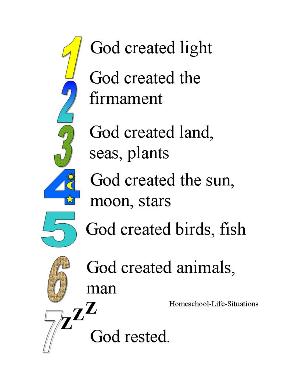
I enjoyed doing a creation unit study with my children. God created the world in seven days. We will look at what He created on each day. The study will combine Bible, science, history, and language arts. I will mention some hands-on activities and field trips to make your study interesting.
This study is a broad overview. Each concept could be expanded and studied in depth.
Your child will learn about light, the atmosphere, the planet earth, plants, birds, fish animals, and man.
I hope that you and your child enjoy the books and activities.
Books to Read
Here is a list of Christian science books to enhance your study. All of the books are available on Amazon. You might also find copies to borrow at your church or public library.
The Amazing Story of Creation from Science and the Bible by Duane T Gish, PH.D is a science book for young people.
The Great Dinosaur Mystery and the Bible by Paul Taylor is about dinosaurs before and after the flood. The book has pictures of dinosaur fossils.
The Genesis Record by Henry Morris is a reference book on Genesis for adults or maybe high school students.
The Institute for creation research has a series of books called The Wonders of Creation. The books in the set are The Astronomy Book, The Cave Book, The Fossil Book, The Geology Book, The Ocean Book, and The Weather Book. The books are also available on Amazon.
For simple science experiments look in the children's section of the library.
Before you begin read Genesis 1:1-2:25 to your children.
If you have younger children read the creation story in a story Bible.
Day 1
In the first day of the creation unit study we will look at light.
Bible
In Genesis 1:3-5 we read that God created light. This made the first day and night.
Look up verses that deal with light such as Psalms 27:1. Matthew 5:14, John 1:4-9, John 8:12. See if you can find other verses.
Science
There are two types of light, natural from sunlight and artificial or man made. Natural light is very important. If we did not have the sun the earth would be very cold. Plants also use the sun to grow. The sun is also part of the water cycle.
On my light experiment page you will learn about some of the properties of light.
History
Read about Thomas Edison and the invention of the light bulb. How has technology changed the way we get and use light?
Language Arts
Write about your day. What did you do? What do you do when it gets dark?
Write a letter to a friend telling them that Jesus is the light of the world.
Write a short report about Thomas Edison. What else did he invent?
If you have young children read and talk about the book Day and Night published by Usborne.
Hands-on Project
Young children can make a candle picture. Cut a slender rectangle out of construction paper. Have your child glue it onto another piece of paper. With yellow or orange paper cut a teardrop shape. Glue it above the rectangle for the flame.
Day 2
In our creation unit study will learn about God making the atmosphere.
Bible
Read Genesis 1:6-8. God created the firmament. The way that I understand it is that God made an atmosphere in the heavens and water on earth.
Science
The atmosphere and water is very important for life on earth. The atmosphere contains oxygen. What else does the atmosphere contain?
The atmosphere has four levels. The levels are troposphere, stratosphere, mesosphere, and thermosphere. Learn about the different levels.
Here are some weather activities.
You can also study about the water cycle.
History
Learn about meteorologists. Weather Grades 5-9 published by Milliken has a section about weather tools and meteorology.
Language Arts
Read poems and nursery rhymes about the weather such as rain, rain, go away or its rain; it’s pouring. There are also poems about the wind and snow.
Hands-on Project
Use cotton balls to represent different types of clouds. For cirrus clouds pull a cotton ball apart. Cirrus clouds are high feathery clouds. Glue pieces to a blue piece of construction paper.
Make puffy clouds to represent cumulus clouds. Use a marker to make the cotton grey.
Status clouds are low clouds that cover the whole sky like a blanket.
Cumulonimbus clouds are grey thunderheads.
Day 3
On the third day of the creation unit study we will study about the creation of land, sea, and plants.
Bible
Read Genesis 1:9-13 God created dry land, seas, and plants.
Science
There is so much to do today. Dry land involves soil, rocks, and land masses.
The seas were made on the third day. You could study about the oceans.
Plants were also created. My page about plant experiments will teach your children about how plants grow. You can also learn about plant classification. Learning about gardening is also a possibility.
History
Look up the history of farming. How was farming different 100 years ago?
Language Arts
An activity that I had my children do was to pretend that they were a flower. They then wrote about how they grew.
Look at nature guides with your children. There are guides for trees, plants, and rocks.
Hands-on projects
Make a topographical map with salt clay. Paint the land green, and water blue.
A fun art project is to use vegetables as stamps. Dip celery into paint then press the paint onto paper. My children also have used a potato as a stamp. Cut the potato in half. On each half cut a design in the potato. Dip the potato in paint. Then stamp it onto paper. We have used the stamps to make wrapping paper and cards.
Seeds can also be used to make pictures. My children have glued seeds onto a wooden cross that they got at a craft store. We also drew pictures on stiff cardboard. We would cut the picture out and glue seeds onto the picture.
Day 4
The fourth day of the creation unit study is about space.
Bible
God created the sun, moon, and stars. See Genesis 1:14-19.
Science
I have written a mini homeschool unit study on stars. It has ideas for Bible, science, language arts, history, art, and music. The study is for elementary aged children, but preschoolers might like to listen to the poems, music, and do the craft.
Besides studying the stars and constellations learn about the planets, the phases of the moon, and different galaxies.
Field trip
A fun field trip is to go to a planetarium. Call a head before you go to see if there are age requirements.
Day 5
In our creation unit study today we will learn about birds and fish.
Bible
Read Genesis 1:20-23. God created birds and fish.
Look up verses that deal with birds and fish such as;
Matthew 10:29-31
Matthew 6:26
Jonah 1:17
Matthew 12:40
Matthew 14:17
Science
Put up a bird feeder and observe the birds in your backyard. Use a field guide to learn their names. Look at a bird feather. Listen to bird calls.
Obtain a whole fish. Find the gills. Look at the scales.
Another idea is to set up an aquarium or fish tank.
History
Study the history of fishing.
Learn the history of bird watching.
Language Arts
Write about what it would be like to fly like a bird. Look up bird terms such as "mad as a wet hen", "chicken" "you eat like a bird". What does each term mean?
Write a story about a fish.
Hands-on Projects
Make a mural of sea life.
Field Trip
Some zoos have an aviary where you can observe birds. Also visit an aquarium to observe fish.
Another idea is to go to a pet store that sells fish or birds.
Day 6
Today in our creation unit study we will learn about the animals and insects that God created.
Bible
God created the animals, creeping things, and man. See Genesis 1:24-31 and Genesis 2:4-25.
Science
Do an overview of the human body.
Study the classification of animals.
Bug, insects, reptiles, and lizards could also be studied.
Language Arts
Write a report on one animal that you like.
Day 7
Bible
Read Genesis 2:1-3. Find other verses about rest.
Science
Study about the importance of rest.
This concludes our creation unit study. We learned that God created everything in seven days. We now have everything that we need for life on earth. We have light, oxygen, and water. We have ground to walk on and plant in. We have trees to shade us. There are plants and animals for food. The sun, moon, and stars help control our environment. God also created items just for our enjoyment. We have amazing sunsets, gems, nice smelling plants, and cute animals. I am thankful for all that God created.
A creation unit study could take a life time to study. A short study can cover the surface of what God created. Some people take a life time and study one animal or some part of the human body.
Return from Creation Unit Study to Homeschooling Science


New! Comments
Leave me a comment in the box below.